
Introduction: The Comforting Lies vs. The Harsh Truths of Stoicism
We live in an era of padded walls and comforting illusions. Modern society whispers a constant, seductive lullaby into our ears: that we are inherently entitled to happiness, that our pain is always someone else’s fault, and that the universe will eventually align to grant us what we desire. We wrap ourselves in these fragile lies to survive the overwhelming complexity of daily life. But step away from the noise. Retreat into the quiet, dimly lit corridors of your own mind, and you will find a different, far more unsettling reality waiting in the shadows.

Two millennia ago, beneath the grand marble colonnades of Rome and the unforgiving sun of Athens, the great thinkers of the ancient world did not traffic in toxic positivity. Emperors, slaves, and statesmen alike turned to a philosophy that offered no false hope, only ironclad resilience. They embraced the harsh truths of Stoicism. This was never meant to be a philosophy of comfort. It is a philosophy of endurance. It demands that we strip away the comforting narratives we construct and stare directly into the raw, unvarnished nature of human existence.
In this essay, we will not offer you easy answers or soft landings. Instead, we are going to pull back the heavy velvet curtains on your own self-deception. We will explore why your suffering is largely of your own making, why your unchecked imagination is your most dangerous enemy, and how embracing the cold, unapologetic reality of the Stoic mindset is the only true path to escaping your mind’s prison.
The comforting lies may keep you warm, but they will keep you chained. Welcome to the harsh truths. Let the illusions burn.
Truth I: You Are the Architect of Your Own Suffering
The most bitter pill to swallow in the Stoic pharmacy is this: you are the architect of your own misery. When a sudden tragedy strikes, when a relationship shatters, or when a grand ambition turns to ash, our immediate, almost primitive instinct is to point a trembling finger at the world. It is a defense mechanism as old as humanity itself—to cast ourselves as the innocent, tragic protagonist in a play written by a cruel and indifferent universe. We find a strange, melancholic comfort in playing the victim.
But Stoicism brutally severs this narrative. Epictetus, a philosopher who spent his early life in the literal, physical chains of slavery, understood the anatomy of freedom far better than the emperors who ruled him. He observed a terrifying but liberating truth: external events are entirely neutral. They are neither inherently good nor inherently bad; they simply are. The heavy rain that ruins your long-awaited plans is the exact same rain that saves a dying harvest. The universe holds no personal malice against you.
The profound suffering you feel does not emanate from the event itself, but from your judgment of it. The very moment you label a situation as a ‘catastrophe,’ an ‘unfairness,’ or a ‘curse,’ you lay the first stone of your own mental prison. You build its walls, brick by brick, with your own resentments, your unchecked emotions, and your desperate, clawing desire for reality to be different than it is.
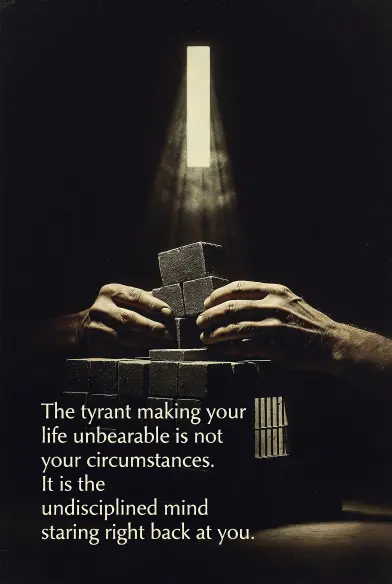
To embrace the harsh truths of Stoicism is to accept radical, unapologetic responsibility for your inner world. You must stand before the mirror in the dim light and realize a haunting fact: the tyrant making your life unbearable is not your circumstances, your enemies, or modern society. It is the undisciplined, reactive mind staring right back at you.
Seneca’s Wisdom: Why We Suffer in Imagination More Than Reality
The night is often the cruelest time for the modern mind. As the world falls silent and the frantic distractions of the day fade into shadows, the grand theater of the mind opens its doors. Here, in the quiet dark, we become the reluctant authors of elaborate tragedies. We lose our livelihoods, we are abandoned by those we love, and we watch our ambitions crumble—all before the sun even rises. We endure agonizing grief for events that have not happened, and in all likelihood, never will.

Seneca the Younger, a statesman who navigated the treacherous, blood-soaked courts of Nero’s Rome, intimately knew the paralyzing grip of anticipation. He lived with the constant, literal threat of execution, yet he penned a letter to his friend Lucilius containing one of the most piercing, undeniable observations in human history: “We suffer more often in imagination than in reality.”
Seneca recognized that the human intellect, while a brilliant evolutionary tool for survival, is also a relentless engine of self-torture. We are a species uniquely capable of dragging the phantoms of a terrifying future into the present moment, crushing ourselves under a weight that does not yet exist. This preemptive mourning drains our vitality. We fight a thousand imaginary wars in our heads, so when we are finally forced to face a real hardship, our spirit is already bruised and exhausted.
To master the harsh truths of Stoicism, you must learn to stand vigilant guard at the gates of your own mind. You must catch yourself the moment you begin to spiral down the abyss of ‘what ifs’ and catastrophic scenarios. (For a more profound exploration of his philosophy and practical steps to silence this inner turmoil, read our dedicated analysis on Seneca on imagination. True Stoic resilience is not about ignoring danger; it is about demanding that your mind stays exactly where your body is—anchored in the present, dealing only with the concrete reality standing right before you.
The Modern Trap: Overthinking and the Stoic Response
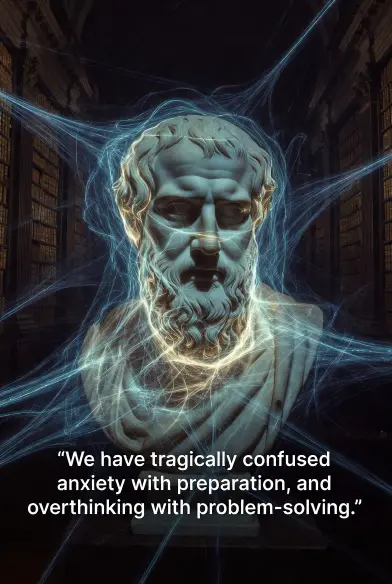
We have traded the physical dangers of antiquity for the psychological torment of modernity. The modern world—with its glowing screens, relentless connectivity, and the infinite scroll of information—is a perfectly engineered incubator for the overactive mind. We no longer flee from predators in the physical world; instead, we are hunted by the relentless ping of notifications, the crushing weight of endless choices, and the perceived judgments of a thousand unseen strangers. We have tragically confused anxiety with preparation, and overthinking with problem-solving.
This is the modern trap: the seductive illusion that if we just analyze a situation deeply enough, if we dissect every delayed text message, every sideways glance, and every catastrophic future outcome, we can somehow manipulate the universe into compliance. But this manic mental pacing in the dead of night is not control. It is paralysis. It is a slow, self-inflicted poison that drains our focus and fractures our peace. We sit in perfectly safe, temperature-controlled rooms, yet our heart rates spike as if we are standing on a blood-soaked battlefield.
The Stoic response to this modern affliction is as brutal as it is necessary. It demands that we cut the cord. To embrace the harsh truths of Stoicism is to realize that the vast majority of the noise echoing in your skull is entirely useless. The ancient philosophers would look at our modern era of hyper-analysis and mourn the wasted energy. When you find yourself drowning in a suffocating sea of digital anxieties and imagined slights, the Stoic command is absolute: halt. Step out of the labyrinth of your own design. Stop intellectualizing your suffering, drop the magnifying glass, and return to the raw, unforgiving, but manageable reality of the present moment.
Marcus Aurelius: Finding Absolute Power Over Your Mind
Picture the freezing, mud-soaked borders of the Germanic frontier in the second century. Inside a dim, solitary tent sits the most powerful man on the face of the earth. As the Emperor of Rome, Marcus Aurelius possessed the absolute authority to command legions, reshape borders, and dictate the life or death of millions. Yet, beneath the flickering, exhausted light of an oil lamp, he did not write treatises on military conquest or political domination. In his private, deeply intimate journal—what we now call Meditations—he wrote desperately about the only territory he truly needed to conquer: his own mind.
Marcus Aurelius understood a terrifying paradox of human existence. You can wear the purple robes of an emperor, you can amass unimaginable wealth, and you can hold the world in your hands, yet still remain a pathetic slave to your own anger, grief, and desires. He faced plagues that decimated his population, the betrayal of his closest generals, and the agonizing deaths of his own children. He knew intimately that external control is the ultimate, seductive illusion. The harsh truth of Stoicism is that the universe will do what it wants. People will betray you, bodies will fail, and empires will eventually crumble to dust.
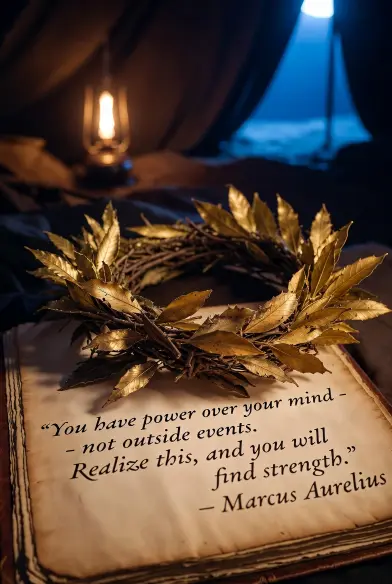
The profound secret to Marcus Aurelius inner peace was not found in subjugating his enemies, but in an uncompromising, daily subjugation of his own ego. (To explore how he practically applied this amid the chaos of his reign, delve into our complete historical breakdown of his battlefield philosophy). He stripped away the grandiosity of his title to remind himself of his own fleeting mortality. He famously wrote: “You have power over your mind – not outside events. Realize this, and you will find strength.” To claim absolute power over your mind is not to banish emotion, but to master your response to it. When the world burns around you, the Stoic emperor teaches us that true, unshakeable sovereignty is found only in the silent, disciplined fortress of the soul.
How to Stop Playing the Victim in Your Own Dark Story
There is a perverse, deeply ingrained comfort in playing the victim. In the grand, sprawling narrative of our own lives, it is infinitely easier to cast ourselves as the tragic hero, perpetually besieged by a coalition of malicious forces: bad luck, ungrateful friends, a broken society, or a profoundly unfair universe. We cling to our grievances and past traumas like cherished heirlooms hidden away in a dusty, forgotten attic. We revisit them, polish them, and display them to anyone willing to look. Why? Because the victim narrative absolves us. If the world is entirely to blame for our stagnation and misery, then we are comfortably excused from the excruciating, terrifying work of changing ourselves.

The harsh truth of Stoicism cuts through this intoxicating delusion like a cold surgeon’s scalpel. It delivers a message that modern society desperately tries to mute: nobody is coming to save you. The cavalry is not waiting just over the horizon. When you meticulously construct a dark, melancholic story where you are eternally wronged, you actively hand the pen of your own life over to your perceived enemies. You reduce yourself to a passive, weeping spectator in your own existence, waiting for an apology from a universe that does not care.
To stop playing the victim, you must execute a ruthless internal coup. You must violently reclaim the pen. Epictetus taught that while we cannot control the violent storms of fate, we retain absolute sovereignty over our own judgments. When you face rejection, when a grand ambition collapses, or when you are deeply insulted, the Stoic mind does not whimper, “Why is this happening to me?” Instead, it demands: “What is this revealing about my own fragility, and how can I use this exact obstacle as fuel?”
This transition is brutal. Shedding the victim identity often feels like tearing off your own skin, because it forces you to look at your own failures without the comforting shield of excuses. But stepping out of your own dark story is the only way to stop merely surviving your life, and finally begin to command it.
The Shift: Transforming External Chaos into Internal Control
The external world is a raging, unpredictable tempest. We exhaust ourselves standing on the shoreline, screaming at the waves to stop crashing. We mistakenly believe that anxiety is a functional tool for manipulation—that if we agonize enough over the collapsing economy, the whispered opinions of our peers, or the inevitable decay of our own bodies, we can somehow hold the chaos at bay. We bleed our mental energy into the void of things we cannot change, leaving us hollow, fragile, and terrified.

But true power, the kind that allowed ancient philosophers to face exile, poverty, and execution with a steady pulse, comes from a radical shift in perspective. It requires drawing a brutal, uncompromising line through the very center of your existence. On one side of this line lies everything you cannot dictate: the past, the weather, the cruelty of strangers, and the sudden tragedies of fate. On the other side lies the only territory you will ever truly own: your own thoughts, your deliberate choices, and the integrity of your character. To master this separation is to master the Stoic dichotomy of control, the ultimate psychological fortress that divides the invincible mind from the fragile ego. (For a complete guide on how to apply this profound concept to silence modern overthinking, explore our dedicated breakdown of this ancient framework).
This shift is the ultimate act of psychological alchemy. When you violently sever your attachment to external outcomes, a profound, almost eerie silence falls over the mind. You stop demanding that the world be fair, and instead demand that you be resilient. The chaos outside will inevitably continue to rage—markets will crash, relationships will fracture, and the world will remain fundamentally unjust. But inside the impenetrable citadel of your mind, there is only absolute, chilling clarity. You no longer merely survive the chaos; you use the heavy anvil of an unpredictable world to forge your own unshakable internal control.
Conclusion: Embracing the Cold Shower of Stoic Philosophy
The harsh truths of Stoicism are not designed to make you feel good. They are designed to make you free. Like a freezing, breathless plunge into icy waters, this philosophy is a violent shock to the system. It forcefully strips away the warm, suffocating blankets of self-pity, the agonizing loops of imaginary suffering, and the desperate, futile demand that the universe bend to your personal desires. It leaves you shivering, exposed, but for the first time in your life, entirely awake.
We have spent too long wandering the dimly lit corridors of our own minds, terrified of the shadows we cast ourselves. We have outsourced our emotional stability to the unpredictable whims of modern society, to the opinions of strangers, and to the illusion of control. But the ancient thinkers—from the enslaved Epictetus to the sovereign Marcus Aurelius—offer us a way out of this self-made prison. The exit is not through positive affirmations or comforting lies. The exit is through absolute, unflinching accountability.
As you step away from this essay and back into the relentless noise of the modern world, carry this uncompromising reality with you: you will face heartbreak, you will endure failure, and you will witness the inevitable decay of time. The external chaos will never cease. But you no longer have to be its victim.
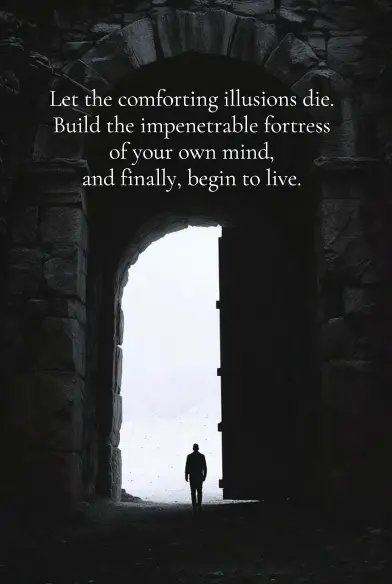
Stand before the mirror, drop the excuses, and embrace the cold shower of Stoic philosophy. Let the comforting illusions die. Build the impenetrable fortress of your own mind, and finally, begin to live.
Explore our
FaceBook: @wevereleftoff.offical
İnstagram: @wevereleftoff.offical
Youtube: @wevereleftoff.offical