

We often look back at the grand sweep of human history and see a chaotic collection of triumphs, tragedies, and accidental discoveries. We comfort ourselves by believing that visionary leaders, brave revolutionaries, and brilliant thinkers bend the arc of history through their sheer willpower and individual genius. However, if you want the Hegel absolute spirit explained, you must prepare to abandon this comforting romanticism.
Table of Contents

G.W.F. Hegel, the towering figure of 19th-century German idealism, proposed a philosophy of history that is as magnificent as it is deeply unsettling. He argued that the timeline of human civilization is not a series of random events driven by human choice. Instead, we are all participating in a meticulously unfolding script, written by an unseen and unstoppable force.
The Illusion of the Great Man Theory
To understand the core of Hegel’s philosophy, we must first look at how we traditionally view historical progress. When we read about Julius Caesar crossing the Rubicon or Napoleon Bonaparte conquering Europe, we assume these men were the ultimate authors of their destinies. They had overwhelming ambition, and they forced the world to bend to their desires.
Hegel shatters this perspective. He introduces the concept that these “world-historical individuals” were completely deceived. They believed they were acting for their own glory, power, or personal passions. In reality, their immense egos and earth-shattering actions were merely tools. They were unknowingly utilized by a macrocosmic force driving toward a singular, predetermined destination. But what exactly is this force?
Understanding the Hegel Absolute Spirit
At the heart of this historical machinery lies the Geist, often translated as Spirit or Mind. When we see the Hegel absolute spirit explained, it is crucial to understand that it is not a traditional, bearded deity sitting in the clouds. Rather, it is the collective consciousness of humanity, the underlying rational structure of reality itself, constantly evolving and moving toward ultimate self-awareness and freedom.
The Absolute Spirit does not exist outside of us; it works through us. Every war, every philosophical breakthrough, and every fallen empire is simply the Spirit progressing through different stages of realization. The tragedy is that the individuals caught in the meat grinder of history are completely unaware of the grand design they are serving. We are the brushstrokes in a masterpiece we will never live to see.
The “Cunning of Reason” and the Disposable Hero
Hegel described this manipulative process with a terrifyingly brilliant term: the List der Vernunft, or the “Cunning of Reason.” The Absolute Spirit is cunning because it uses human passion, violence, and self-interest as the very engine of its own progress.
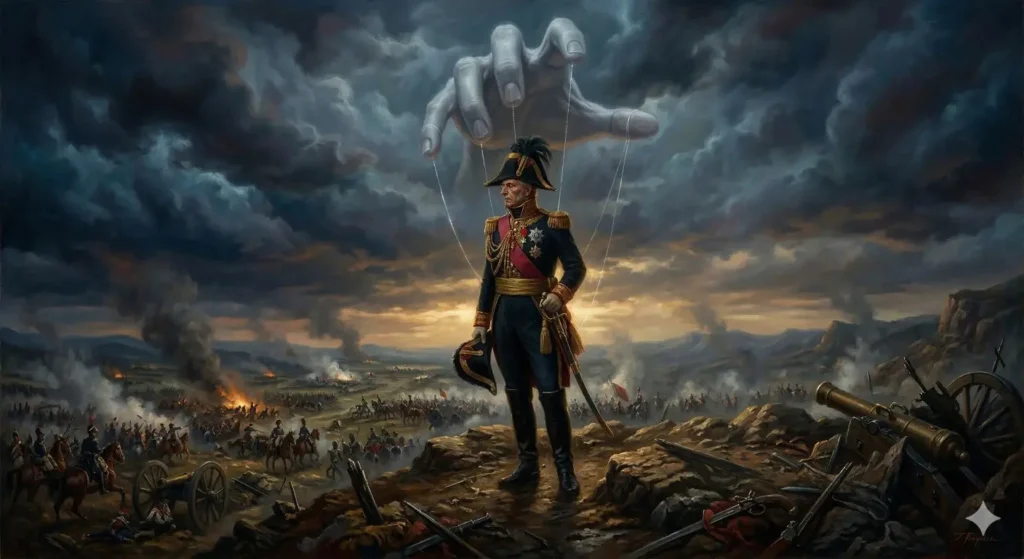
Take Napoleon, whom Hegel famously saw riding through Jena and described as “the world-soul on horseback.” Napoleon thought he was conquering for the glory of France and his own legacy. But the “Cunning of Reason” was simply using Napoleon’s insatiable ambition to spread the ideals of the French Revolution—laws, bureaucracy, and the concept of individual rights—across a fractured Europe.
Once these great figures serve their purpose, the Spirit brutally discards them. Caesar is assassinated; Napoleon is exiled to die on a lonely island. They are squeezed dry by history and thrown away. They were never truly free; they were the most tragic pawns of all.
Are We All Merely Pawns?
If the titans of history were merely disposable instruments wielded by an invisible hand, what does that make the rest of us? For the ordinary person, the realization of the Absolute Spirit can induce a profound sense of vertigo. It suggests that our personal struggles, our political devotions, and our societal advancements are just inevitable gears turning in a cosmic machine.

Yet, within this deterministic nightmare, there is a strange, melancholic beauty. We are part of something infinitely larger than ourselves. Even if our choices are illusions, the roles we play are entirely necessary for the ultimate realization of human consciousness.
Connect the Threads: The historical strings of Hegel and the biological trap of Schopenhauer ultimately lead us to the same terrifying question about human agency. To see how these dark philosophies intertwine, read our comprehensive pillar guide: .
Explore our
FaceBook: @wevereleftoff.offical
İnstagram: @wevereleftoff.offical
Youtube: @wevereleftoff.offical